


Measuring what matters
Know which programmes create value for your communities, your stakeholders and your business, and where to invest next.
Going beyond
Purpose
Most companies invest in their communities. Fewer can show what changed as a result. Counting activities, participants and hours tells part of the story. It does not show whether a programme works, for whom, or how it connects to the business.
Social impact measurement closes that gap. It is how a shared value strategy shows it is working.
From activity
To evidence
Measurement should help you decide. Which programmes meet your impact goals? Where should we invest next? Do community outcomes support corporate purpose, or even business performance? Once you can answer these questions, the same evidence serves your ESG disclosures, investor conversations and board reporting.
Expectations are also evolving. HKEX continues to expand ESG reporting requirements. In Hong Kong, sustainability-linked financing has started to include social value indicators.

We co-design each measurement framework with the people who run the programmes, so it reflects how the work is actually done. We apply recognised social value principles, including accounting for what would have happened anyway, so the figures hold up to scrutiny. We can also work with your NGO partners, so the organisations delivering your programmes collect consistent data and speak the same language.
You can start with one programme and extend the framework over time.
Build the framework
- Theory of Change: co-design sessions that map your programmes from inputs to outcomes and define the shared impact areas that link community investment to real change.
- Survey Design & Data Collection: bespoke question banks and survey methods, piloted and validated with the people your programmes serve.
Prove the impact
- Net Impact Calculation: adjusted impact metrics and, where defensible, monetised outcomes that translate community investment into business language.
- Reporting & Capacity Building: an impact report or dashboard with a shared value narrative, plus workshops so your teams can run the framework independently.
In practice
Case study
A cross-departmental framework for a Hong Kong real estate group
A large Hong Kong real estate group runs shopping centres close to public housing estates. It invests steadily in community programmes, placemaking, scholarships and NGO partnerships. What it lacked was a shared way to measure outcomes across departments.
We brought its Corporate Affairs and Asset Management teams together to co-design a Theory of Change around three shared impact areas. We then built a survey bank of standardised yet customisable questions and validated it across five pilots with around 500 respondents.
The Group now has a replicable measurement system with five KPIs. The full findings will be shared in a white paper to be published soon.
Part of
A connected journey
Measurement is most useful when it is connected to strategy.
- It tells you whether your shared value strategy is working and where to adjust it.
- It shows the teams and NGO partners you have engaged what their work has contributed.
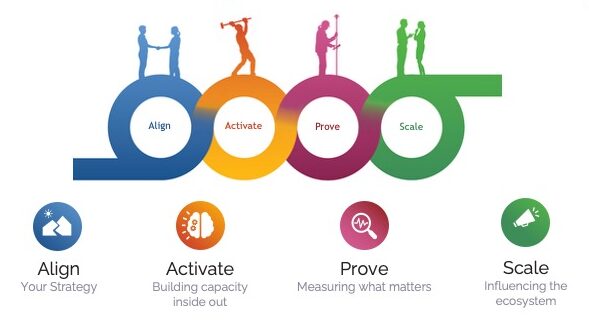
Each stage stands on its own. Some organisations start with Advisory, others with Capacity Building. Others start with measurement and return to strategy with better evidence.
Making
It Happen
Every shared value strategy engagement starts with understanding your context: your business, your existing commitments, and where you want to go. A short conversation, usually 20 to 30 minutes, is enough to know whether and how we can help.