

What Happens When an Office Fit-out Company Decides to Close the Loop?
Overview
How JEB Group turned a sustainability conviction into a circular economy business, and why it changes the game for corporate clients across Asia.
When Rob Wall, CEO of JEB Group, attended a Shared Value Initiative Hong Kong event a few years ago, something clicked. JEB had spent over three decades building a reputation for high-quality office partitions and bespoke furniture across Asia. But the more Rob thought about what happened to that furniture & partitions at the end of a lease, the discarded desks, the chairs heading to landfill, the tonnes of embodied carbon erased in a single office move, the harder it became to ignore.
“Sustainability is critical to businesses, our people and our planet. We believe in inciting and enabling change to create workplaces that improve productivity and create a sense of community and wellness, all whilst reducing waste and our carbon footprint.”
Rob Wall, JEB Group Chief Executive Officer
That conviction led to the creation of Sustainable Office Solutions (SOS) in 2022, a startup venture backed by JEB Group, dedicated to giving unwanted office furniture a second life rather than a landfill burial.
The Problem with Office Moves
Office furniture accounts for around 10% of a building’s overall environmental impact, a figure that adds up fast in a city like Hong Kong, where companies are constantly relocating, downsizing, or redesigning their workspaces. When a company moves out, the default is typically disposal: furniture gets stripped out, piled up, and sent away. Most of it is still perfectly usable.
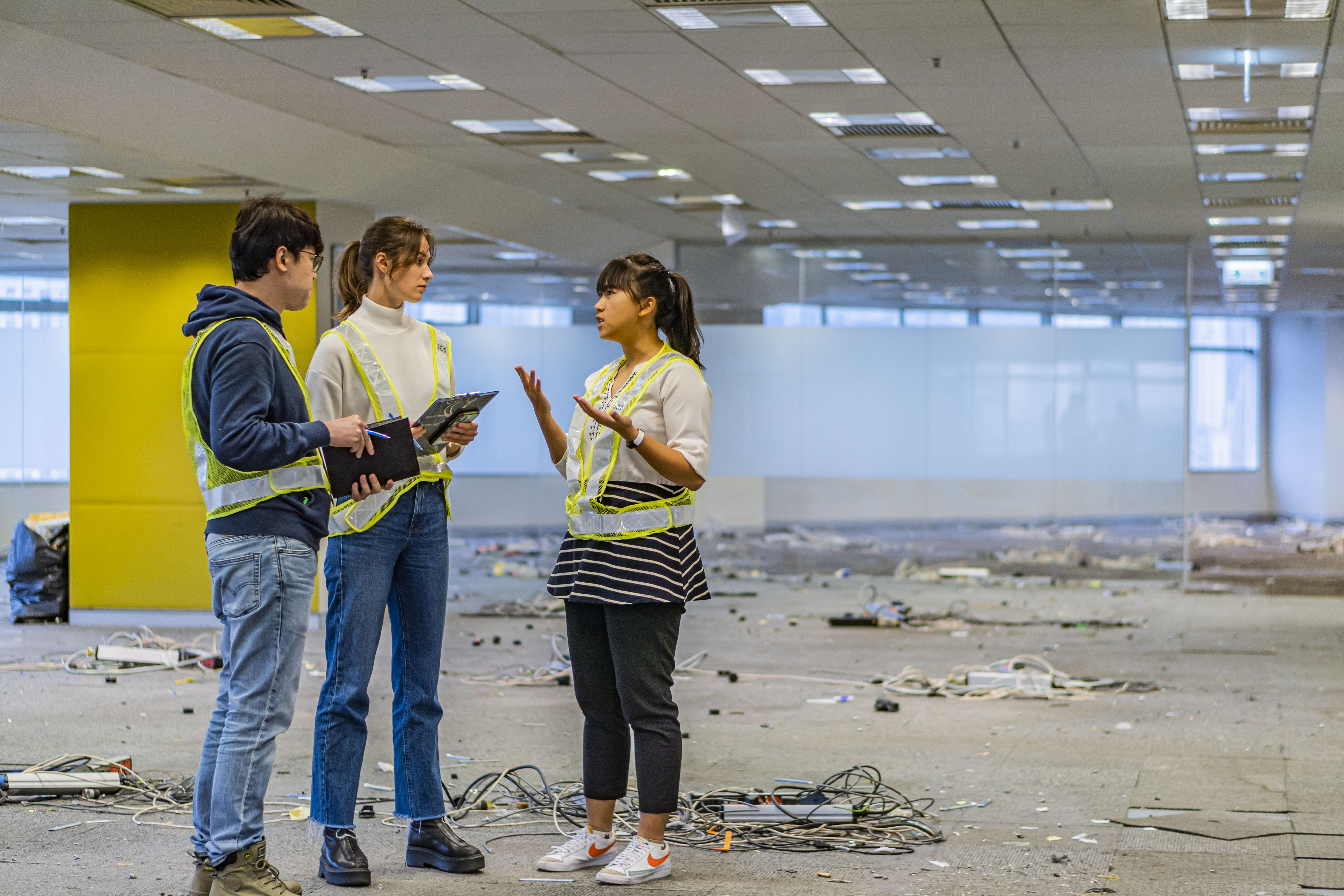
SOS was built to change that default. When a corporate client relocates or clears out a workspace, SOS conducts a comprehensive inventory audit and grades every asset – chairs, desks, partitions, electronics – before deciding on the most sustainable path for each item. That might mean reuse by the client in a new location, a staff take-home programme, donation to NGOs and community organisations, repurposing into something new, or, as a last resort, recycling.
At the end of every project, the client receives an Impact Report: a quantified account of carbon emissions avoided and materials diverted from landfill, calculated in alignment with ISO 14064-2 methodology and independently verified.
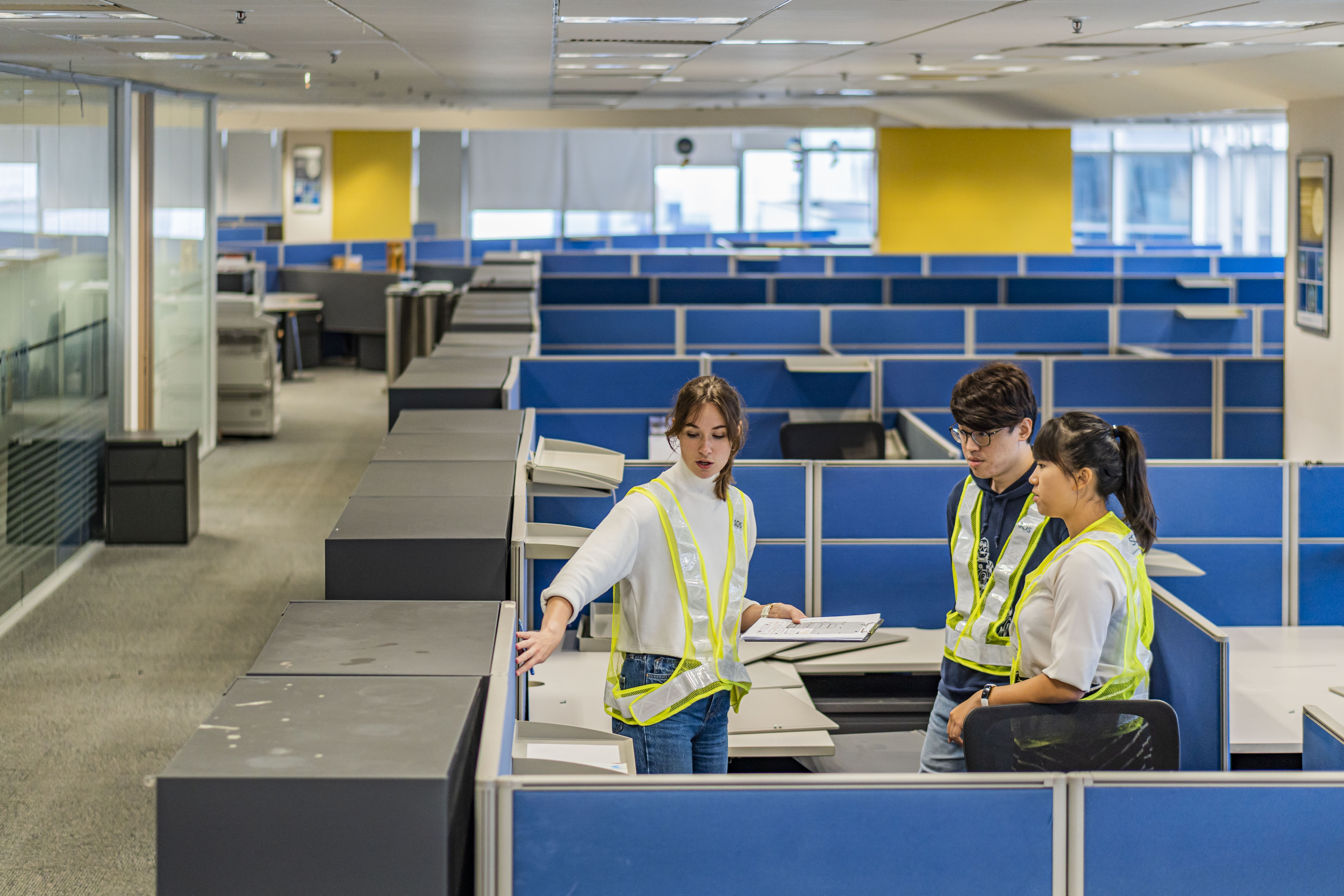
Image provided by JEB Group
From Furniture to Impact
The results speak for themselves. In one landmark project with a local landlord, the first real estate company in Hong Kong and mainland China to receive approval from the Science Based Target initiative (SBTi) for its emissions reduction targets, SOS helped manage a major office rejuvenation. The outcomes were striking:
- 99.5% of assets diverted from landfill through redistribution and recycling
- 603,186kg CO₂e of embodied carbon emissions avoided
- 180,881 kg of materials kept out of the waste stream
- 467 pieces of furniture and equipment donated to 14 local and regional NGOs, including Crossroads Foundation, Oxfam HK, and HK PHAB Association
- 212 items taken home by employees through a staff take-home programme
“NGOs often prioritise resources to directly impact the people they serve, which leaves limited budget for furnishing their service centres and offices.”— Crossroads Foundation
The donation did more than clear a storage problem: it furnished spaces where communities gather and receive support.
Across all its projects since 2021, SOS has collectively avoided 11 million+ kg of CO₂e emissions — a figure that puts the scale of the programme’s environmental impact well beyond any single client engagement.
The Shared Value Strategy
SOS is not a charity project: it is a business. Services range from inventory management and responsible asset redistribution to carbon impact data and ESG reporting support for clients seeking to demonstrate progress on their Scope 3 emissions targets. Since 2021, SOS has completed 274 projects across the region, achieving an average landfill diversion rate of 96% and delivering clients savings of HK$100,000 to HK$300,000 in commercial waste disposal fees per project.
The model works because it aligns incentives on all sides. Corporate clients save on decommissioning and reinstatement costs, reduce their furniture capital expenditure, and gain verified, ISO-aligned ESG data they can use in sustainability reporting. NGOs and community organisations receive high-quality furniture at no cost. And JEB Group strengthens its positioning as a comprehensive, sustainability-led partner, offering clients a 360° solution from green procurement to responsible end-of-life asset management.
In late 2024, SOS announced a strategic partnership with a leading global real estate company, combining SOS’s specialisation in ethical and sustainable office clearances with their extensive network and reach across the APAC region. This is a significant step in scaling the model beyond JEB’s existing client base to the broader real estate market. SOS has now reached profitability in Singapore in 2025, where mandatory ESG reporting requirements have driven faster client uptake, and is on track to achieve the same in Hong Kong as large-scale and recurring contracts continue to grow. This proves that the circular economy model is not just environmentally sound, but commercially viable.
This track record was recognised at the 2025 Shared Value Awards, where SOS received the Shared Value Excellence award, a judges’ special recognition for its achievement of 96% average landfill diversion across 233 projects and 8.4 million kg CO₂e avoided since inception.
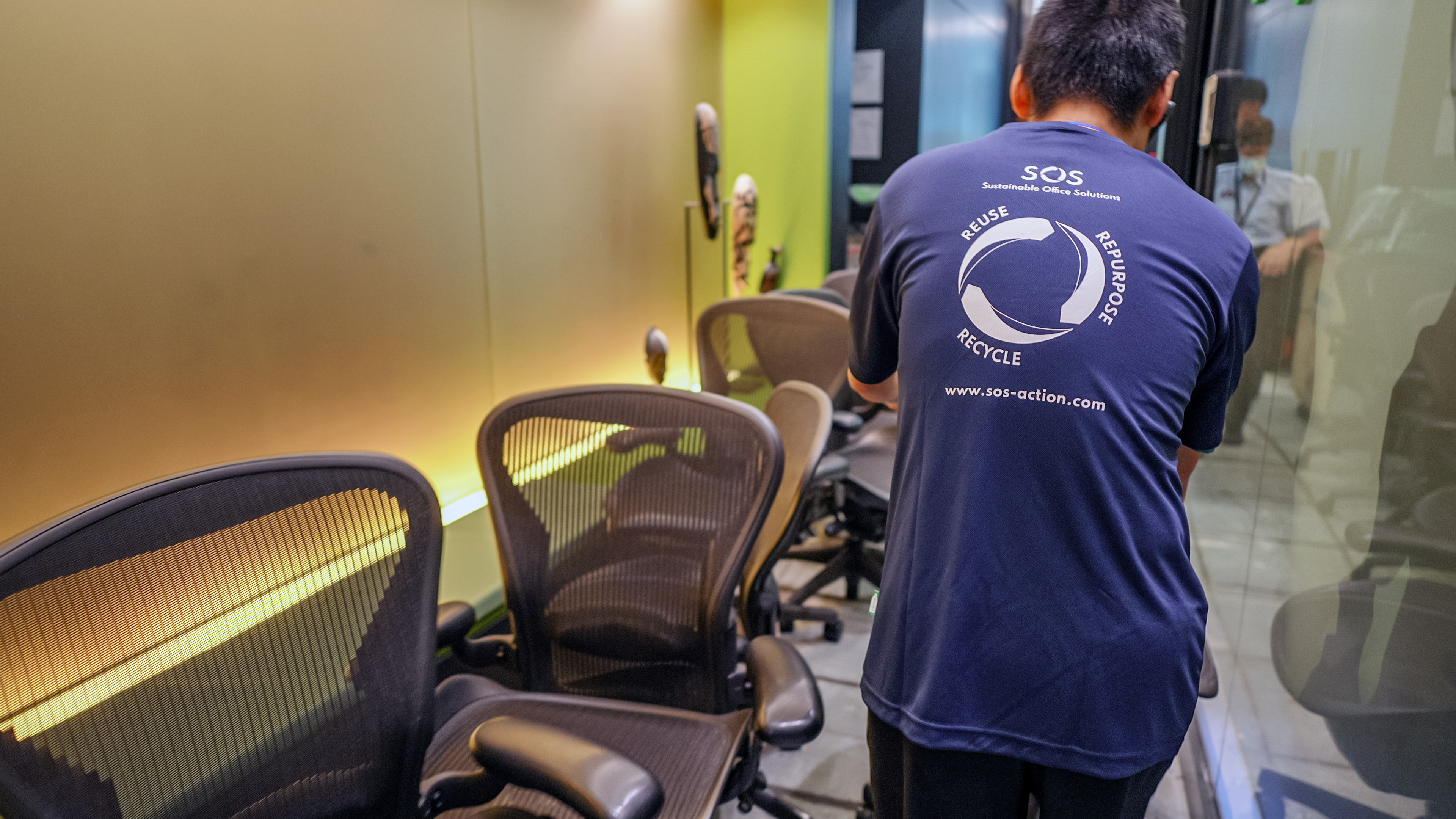
Image provided by JEB Group
Sustainability is critical to businesses, our people and our planet. We believe in inciting and enabling change to create workplaces that improve productivity and create a sense of community and wellness, all whilst reducing waste and our carbon footprint.”
Sustainability as a Shared Purpose
What is perhaps most instructive about the JEB-SOS story is not the business model itself, but how sustainability has reshaped the entire group from within. Since SOS’s creation, sustainability has become a shared purpose across JEB, influencing supplier selection, product design, and how sales teams engage clients. JEB now works exclusively with furniture suppliers that meet high environmental standards. Since 2025, JEB’s office furniture and partitions have met the most rigorous environmental standards and are designed to support LEED certification for eco-friendly offices. What started as a separate sustainability venture ended up redefining what JEB Group sells, and who it buys from.
A 2025 employee survey found that 70% of JEB staff are very familiar with the company’s sustainability goals, 54% have incorporated sustainable habits into their daily work, and 33% feel highly engaged in advancing the company’s sustainability efforts. New joiners, or “JEBBERs”, receive a sustainability onboarding handbook from day one.
The Group has also joined the United Nations Global Compact, committing to its Ten Principles on human rights, labour, environment, and anti-corruption. JEB’s sustainability work now features in the ESG reports of major real estate developers across the region.
The Bigger Picture
JEB and SOS show what Creating Shared Value looks like in practice in the built environment: a company using its core expertise not to sell more products, but to solve a real problem – the enormous waste embedded in how businesses manage their physical spaces – in a way that generates measurable environmental, social, and commercial returns simultaneously.
The circular economy in office furniture is still a nascent market in Asia, but regulatory pressure is building fast. As ESG reporting requirements tighten across the region, the companies that have already built the expertise, tools, and track record to help clients measure and reduce their Scope 3 emissions will have a significant head start. JEB and SOS are already there.
NGOs and social enterprises receive high-quality second-hand furniture at no cost, freeing budgets for frontline services
| Societal benefits | Economic benefits |
| Sustainability is embedded across the full value chain, advancing the circular economy in the built environment | 360° service offering strengthens JEB’s competitive positioning and client retention |
| Measurable Scope 3 emissions reductions; 100% landfill diversion achievable; independently verified carbon impact aligned with ISO 14064-2 | Reduced decommissioning and reinstatement costs; lower furniture CAPEX; verified ESG data ready for sustainability reporting |
| Furniture donations support causes ranging from poverty alleviation and disability services to youth programmes and animal welfare | NGOs and social enterprises receive high-quality second-hand furniture at no cost, freeing budgets for frontline services |
| Circular economy practices in office furniture, financially viable, are normalising responsible asset management as an industry standard | Partnership with global real estate companies extends SOS’s model across APAC, creating scalability opportunities |